nanotechnology

Showing posts with label Nanocantilevers. Show all posts

scientists tame tricky carbon nanotubes

MIT materials scientists tame tricky carbon nanotubes, Deborah Halber, News Office Correspondent, September 15, 2006

MIT researchers have discovered that certain molecules can attach themselves to metallic carbon nanotubes without interfering with the nanotubes' exceptional ability to conduct electricity. At left, the high conductance state has two molecular orbitals, shown in green. Some molecules even let the nanotube switch between highly conductive, left, and poorly conductive (right, with one red molecular orbital), creating the potential for new applications. Image courtesy / Marzari Lab.Based on a new theory, MIT scientists may be able to manipulate carbon nanotubes --
one of the strongest known materials and one of the trickiest to work with -- without destroying their extraordinary electrical properties.

The work is reported in the Sept. 15 issue of Physical Review Letters, the journal of the American Physical Society.

Carbon nanotubes -- cylindrical carbon molecules 50,000 times thinner than a human hair -- have properties that make them potentially useful in nanotechnology, electronics, optics and reinforcing composite materials. With an internal bonding structure rivaling that of another well-known form of carbon, diamonds, carbon nanotubes are extraordinarily strong and can be highly efficient electrical conductors.

The problem is working with them. There is no reliable way to arrange the tubes into a circuit, partly because growing them can result in a randomly oriented mess resembling a bowl of spaghetti.

Researchers have attached to the side walls of the tiny tubes chemical molecules that work as "handles" that allow the tubes to be assembled and manipulated. But these molecular bonds also change the tubes' structure and destroy their conductivity.

Now Young-Su Lee, an MIT graduate student in materials science and engineering, and Nicola Marzari, an associate professor in the same department, have identified a class of chemical molecules that preserve the metallic properties of carbon nanotubes and their near-perfect ability to conduct electricity with little resistance.

Using these molecules as handles, Marzari and Lee said, could overcome fabrication problems and lend the nanotubes new properties for a host of potential applications as detectors, sensors or components in novel optoelectronics.

Playing with atoms
Marzari and Lee use the fundamental laws of quantum mechanics to simulate material properties that are difficult or impossible to measure, such as molten lava in the Earth's core or atomic motion in a fast chemical reaction. Then they run these simulations on interconnected PCs and use the results to optimize and engineer novel materials such as electrodes for fuel cells and polymers that contract and expand like human muscles.

With the help of a powerful algorithm created by Lee and published last year in Physical Review Letters, the theorists focused on solving some of the problems of working with carbon nanotubes.

Like fuzzy balls and Velcro, the hexagon of carbon that makes up a nanotube has a predilection for clinging to other hexagons. One of the many challenges of working with the infinitesimally small tubes is that they tend to stick to each other.

Attaching a molecule to the sidewall of the tube serves a double purpose: It stops nanotubes from sticking so they can be processed and manipulated more easily, and it allows researchers to control and change the tubes' electronic properties. Still, most such molecules also destroy the tubes' conductance because they make the tube structurally more similar to a diamond, which is an insulator, rather than to graphite, a semi-metal.

Lee and Marzari used Lee's algorithm to identify a class of "molecular handles" (carbenes and nitrenes) that stop this from happening and preserve the tubes' original conductivity. "We now have a way to attach molecules that allows us to manipulate the nanotubes without losing their conductance," Marzari said.

Carbenes and nitrenes work by breaking a molecular bond on the nanotube's wall while creating their own new bond to the tube. This process -- one bond formed, one bond lost -- restores the perfect number of bonds each carbon atom had in the original tube and "conductance is recovered," Marzari said.

Some molecular handles can even transform between a bond-broken and a bond-intact state, allowing the nanotubes to act like switches that can be turned on or off in the presence of certain substances or with a laser beam. "This direct control of conductance may lead to novel strategies for the manipulation and assembly of nanotubes in metallic interconnects, or to sensing or imaging devices that respond in real-time to optical or chemical stimuli," Marzari said.

The next step is for experiments to confirm that the approach works.

This work is supported by the MIT Institute for Soldier Nanotechnologies and the National Science Foundation

Camera for Molecules

A Leading Edge Camera for Molecules, Max Planck researchers in Heidelberger film fast molecular motion for the first time.

Fig.1: One of the many snapshots that the physicists took of the heavy hydrogen molecule. Each dot in the image represents a specific angle between laser polarisation and the molecular axis and a specific distance to the deuterium nuclei. The constellations marked in red occur more frequently. Image: Max Planck Institute for Nuclear Physics.Fig.1: One of the many snapshots that the physicists took of the heavy hydrogen molecule. Each dot in the image represents a specific angle between laser polarisation and the molecular axis
and a specific distance to the deuterium nuclei. The constellations marked in red occur more frequently. Image: Max Planck Institute for Nuclear Physics.
Fig. 2: Development of the wave packet over a period of time. The distance between the deuterium nuclei (R) is plotted against the time. After approximately 100 femtoseconds, the wave packet, i.e. the location of the nuclei, starts to become hazy, after 400 femtoseconds there is a Fig. 2: Development of the wave packet over a period of time. The distance between the deuterium nuclei (R) is plotted against the time.
After approximately 100 femtoseconds, the wave packet, i.e. the location of the nuclei, starts to become hazy, after 400 femtoseconds there is a "revival" and the wave packet is put back together again. Image: Max Planck Institute for Nuclear Physics.

Researchers at the Max Planck Institute for Nuclear Physics in Heidelberg have visualised vibration and rotation in the nuclei of a hydrogen molecule as a quantum mechanical wave packet. What is more, this has been achieved on an extremely short spatio-temporal scale. They "photographed" the molecule using intensive, ultrashort laser pulses at different points in time and compiled a film from the separate images. This allowed them to visualise the quantum mechanical wave pattern of the vibrating and rotating molecule (Physical Review Letters, Online-Edition, November 6, 2006).

Cameras and light microscopes are not viable options when photographing molecules: a hydrogen molecule is around 5,000 times smaller than the wavelength of visible light and it is therefore not possible to create an optical image of these molecules. Instead, for some time Max Planck researchers have been using pump-probe technology to make high-resolution and ultrahigh-speed images. The molecules are first "bumped" with a "pump" laser pulse and then after a specific time measured with a "probe" laser pulse.

The scientists are particularly interested in the smallest and fastest molecule, the hydrogen molecule. In order to create an image of the ultrafast molecular motion, laser pulses in the past have lasted too long. The two nuclei in the hydrogen molecule vibrate backwards and forwards so quickly that even visible light only vibrates five times in the same time. However, as in photography, creating a sharp image of fast events requires extremely short exposure time.

To shorten the "exposure time", researchers at the Max Planck Institute for Nuclear Physics developed pump-probe apparatus with an average laser pulse duration of only six to seven femtoseconds, allowing molecular motion to be measured continuously for the first time. By comparison, light, which can orbit the earth around eight times in one second, only travels around two thousandths of a millimetre in seven femtoseconds. The scientists had to overcome tremendous technical challenges in accomplishing this. They kept the interval between the laser pulses stable to within 0.3 femtoseconds. Light only travels 100 nanometres in this time. For this reason, the optical components of the experiment were not allowed to move more than 500 atom diameters in relation to each other while the measurement was being taken.

For the measurement, the researchers used deuterium molecules, a compound of two heavy hydrogen atoms. They are not energetically excited, and are therefore in the quantum mechanical ground state. The first pump laser pulse removes an electron from a deuterium molecule and it is ionised. Adjusting to the new situation, the two nuclei of the ionised deuterium molecule move further apart and vibrate around a new resting position. The pump pulse also makes the molecule rotate. With the subsequent probe laser pulse the scientists remove the second electron from the molecule; as there are now no more electrons available for fusion and the positively charged nuclei repel each other, the remains of the molecule "explode"; the closer the two nuclei are to each other when the second ionisation takes place, the more violent the explosion. Using a "reaction microscope" which they developed some time ago, the researchers measure the energy of the two deuterium nuclei from which they calculate the distance between them and their positions at the moment of explosion. Altering the interval between the pump pulse and the subsequent probe pulse allows a snapshot of the movement of the nucleus at different times to be made (see fig. 1). A sequence of the separate images produces a "molecular film", giving an insight into the molecular dynamic.

In quantum mechanical terms, the vibrating deuterium nuclei are equivalent to a wave packet which starts off as a compact system and after a certain time breaks up - physicists call this "delocalising"; it is similar to the way a crowd of differently paced runners initially clumps together at the start of the track and after a while string out. This break up can be seen in Fig. 2. At the beginning, the movement measured in the wave packet (and thus in the nuclei) is still well localised, i.e. the pack of runners is still relatively dense and compact. After approximately 100 femtoseconds, the structure becomes "fuzzy" or delocalised: the runners are strung out along the whole of the track. The physicists were able to create an image in space and time of this "wave packet collapse". Furthermore, they also recorded how the wave packet regrouped after approximately 400 femtoseconds - there was a "revival". Using the image of the long-distance race, this means that the runners group together again in a dense crowd after a certain period.

With their extremely fast molecule camera, the researchers in Heidelberg have for the first time created a complete image of the dynamic of one of the fastest molecular systems over a previously unachieved short time scale. In future, by modelling the pump laser pulse, the wave packet will be created so that certain quantum mechanical processes take place in preference to others. The scientists want to manipulate and control the chemical reactions of larger molecules in this way. Experiments of this kind are already being carried out on methane molecules in the laboratory in Heidelberg.

Max Planck Society for the Advancement of Science Press and Public Relations Department. [1] VIDEO IN AVI FORMAT, Visualisation of the quantum mechanical wave patterns of a vibrating and spinning molecule

Hofgartenstrasse 8, D-80539 Munich, PO Box 10 10 62, D-80084 Munich, Phone: +49-89-2108-1276, Fax: +49-89-2108-1207

E-mail: presse@gv.mpg.de Internet: http://www.mpg.de/, Responsibility for content: Dr. Bernd Wirsing (-1276)

Executive Editor: Dr. Andreas Trepte (-1238), Online-Editor: Michael Frewin (-1273), ISSN 0170-4656.

Original work: Th. Ergler, A. Rudenko, B. Feuerstein et al. Spatio-Temporal Imaging of Ultrafast Molecular Motion: ‘Collapse’ and Revival of D2+ Nuclear Wave Packet, Physical Review Letters, Vol. 97, No. 19, November 6, 2006 IN PDF FORMAT (166 KB)

Contact: Dr. Thorsten Ergler Max Planck Institute for Nuclear Physics, HeidelbergTel.: +49 6221 516-452Fax: +49 06221 516-604E-mail: thorsten.ergler@mpi-hd.mpg.de

A quantum (computer) step

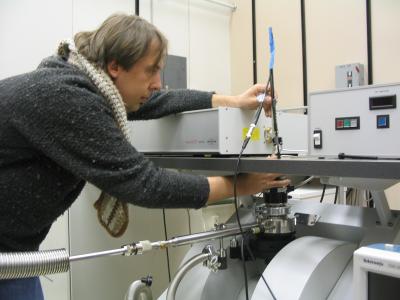
Caption: University of Utah physicist Christoph Boehme works with equipment that he uses to show it it feasible for a superfast quantum computer of the future to read data that is stored in the form of magnetic 'spins' of phosphorus atoms. Credit: John Lupton, University of Utah, Usage Restrictions: NoneStudy shows it's feasible to read data stored as nuclear 'spins'. A University of Utah physicist took a step toward developing a superfast computer based on the weird reality of quantum physics
by showing it is feasible to read data stored in the form of the magnetic "spins" of phosphorus atoms.

"Our work represents a breakthrough in the search for a nanoscopic [atomic scale] mechanism that could be used for a data readout device," says Christoph Boehme, assistant professor of physics at the University of Utah. "We have demonstrated experimentally that the nuclear spin orientation of phosphorus atoms embedded in silicon can be measured by very subtle electric currents passing through the phosphorus atoms."

The study by Boehme and colleagues in Germany will be published in the December issue of the journal Nature Physics and released online Sunday, Nov. 19.

"We have resolved a major obstacle for building a particular kind of quantum computer, the phosphorus-and-silicon quantum computer," says Boehme. "For this concept, data readout is the biggest issue, and we have shown a new way to read data."

Boehme, who joined the University of Utah faculty earlier this year, conducted the study with Klaus Lips – a former colleague at the Hahn-Meitner Institute in Berlin – and with graduate students Andre Stegner and Hans Huebl and physicists Martin Stutzmann and Martin S. Brandt of the Technical University of Munich.

A Bit about Quantum Computing

In modern digital computers, information is transmitted by flowing electricity in the form of electrons, which are negatively charged subatomic particles. Transistors in computers are electrical switches that store data as "bits," in which "off" (no electrical charge) and "on" (charge is present) represent one bit of information: either 0 or 1.

For example, with three bits, there are eight possible combinations of 1 or 0: 1-1-1, 0-1-1, 1-0-1, 1-1-0, 0-0-0, 1-0-0, 0-1-0 and 0-0-1. But three bits in a digital computer can store only one of those eight combinations at a time.

Quantum computers, which have not been built yet, would be based on the strange principles of quantum mechanics, in which the smallest particles of light and matter can be in different places at the same time.

In a quantum computer, one "qubit" – quantum bit – could be both 0 and 1 at the same time. So with three qubits of data, a quantum computer could store all eight combinations of 0 and 1 simultaneously. That means a three-qubit quantum computer could calculate eight times faster than a three-bit digital computer.

Typical personal computers today calculate 64 bits of data at a time. A quantum computer with 64 qubits would be 2 to the 64th power faster, or about 18 billion billion times faster. (Note: billion billion is correct.)

Researchers are exploring many approaches to storing and processing information in nanoscopic form – on the scale of molecules and atoms, or one billionth of a meter in size – for quantum computing. They include optical quantum computers that would hold data in the form of on-off switches made of light, ions (electrically charged atoms), the size or energy state of an electron's orbit around an atom, so-called "quantum dots" of material and the "spins" or magnetic orientation of the centers or nuclei of atoms.

A New Spin on Quantum Computers

Boehme's new study deals with an approach to a quantum computer proposed in 1998 by Australian physicist Bruce Kane in a Nature paper titled "A silicon-based nuclear spin quantum computer." In such a computer, silicon – the semiconductor used in digital computer chips – would be "doped" with atoms of phosphorus, and data would be encoded in the "spins" of those atoms' nuclei. Externally applied electric fields would be used to read and process the data stored as "spins."

Spin is difficult to explain. A simplified way to describe spin is to imagine that each particle – like an electron or proton in an atom – contains a tiny bar magnet, like a compass needle, that points either up or down to represent the particle's spin. Down and up can represent 0 and 1 in a spin-based quantum computer, in which one qubit could have a value of 0 and 1 simultaneously.

In the new study, Boehme and colleagues used silicon doped with phosphorus atoms. By applying an external electrical current, they were able to "read" the net spin of 10,000 of the electrons and nuclei of phosphorus atoms near the surface of the silicon.

A real quantum computer would need to read the spins of single particles, not thousands of them. But previous efforts, which used a technique called magnetic resonance, were able to read only the net spins of the electrons of 10 billion phosphorus atoms combined, so the new study represents a million-fold improvement and shows it is feasible to read single spins – something that would take another 10,000-fold improvement, Boehme says.

But the point of the study, he adds, is that it demonstrates it is possible to use electrical methods to detect or "read" data stored as not only electron spins but as the more stable spins of atomic nuclei.

"We discovered a mechanism that will allow us to measure the spins of the nuclei of individual phosphorus atoms in a piece of silicon when the phosphorus is close [within about 50 atoms] to the surface," Boehme says. With improved design, it should be possible to build a much smaller device that "lets us read a single phosphorus nucleus."

Details of the Experiment

The researchers used a piece of silicon crystal about 300 microns thick – about three times the width of a human hair – less than 3 inches long and about one-tenth of an inch wide. The silicon crystal was doped with phosphorus atoms. Phosphorus atoms were embedded in silicon because too many phosphorus atoms too close together would interact with each other so much that they couldn't store information. The concept is that the nuclear spin from one atom of phosphorus would store one qubit of information.

The scientists used lithography to print two gold electrical contacts onto the doped silicon. Then they placed an extremely thin layer of silicon dioxide – about two billionths of a meter thick – onto the silicon between the gold contacts. As a result, the device's surface had tiny spots where the spins of phosphorus atoms could be detected.

The scientists applied a tiny voltage to the gold contacts, creating an electrical current perhaps 10,000 times smaller than that produced by an AA-size battery, Boehme says. When the current was measured during 100 millionths of a second, it stayed constant, indicating the spins of the phosphorus atoms in the silicon were random, with half pointing up and half pointing down.

Then the device was chilled with liquid helium to 452 degrees below zero Fahrenheit. That made most of the phosphorus spins point down. Next, the researchers applied a magnetic field and microwave radiation to the sample, which makes the phosphorus spins constantly flop up and down in concert for a few billionths of a second.

As a result, the electrical current fluctuated up and down.

"That is basically a readout of phosphorus electron spins," which, in turn, also can be used to determine the spins of the phosphorus atoms' nuclei based on a previously known relationship between electron spins and nuclear spins, Boehme says.

While Boehme is excited by this advance, numerous obstacles remain before quantum computing becomes a reality.

"If you want to compare the development of quantum computers with classical computers, we probably would be just before the discovery of the abacus," he says. "We are very early in development." ###


Contact: Christoph Boehme
boehme@physics.utah.edu 801-859-7896 (cellular) 801-581-6806 (office) 801-581-6992 (lab)

Lee Siegel
leesiegel@ucomm.utah.edu 801-244-5399 (cellular) 801-581-8993 (office) University of Utah

University of Utah Public Relations 201 Presidents Circle, Room 308 Salt Lake City, Utah 84112-9017 (801) 581-6773 fax: 585-3350
unews.utah.edu
Related Posts Plugin for WordPress, Blogger...

Visitors


free counter
Advertise my site free UseAds.com! Add & submit url & exchange text links + increase traffic & improve page rank!

Advertising my web site free online UseAds.com - Add & submit url & exchange text links + increase traffic & promotion marketing website